- Understand how quality control works at a shared plant with ISO 9001 across brands producing on the same line.
- DBS applies torque traceability, static and dynamic inspection, a dynamometer, and a battery lab, process details most manufacturers only describe in generic terms.
- ISO 9001 certification isn’t a marketing seal: it’s an auditable method that has to apply equally to every brand producing on the same line.
Shared plant with ISO 9001 across brands is the model that raises a recurring question: is quality control really the same for every brand producing on the same plant?
In this article you’ll understand how ISO 9001 applies in a shared operation, which mechanisms guarantee the same standard across brands, and where the difference lies between a well-controlled line and a line that’s merely certified.
Understanding this process avoids decisions based only on the seal and helps your brand confidently assess the real standard it will receive.
DBS’s ISO 9001 seal represents this certification in practice. But, as you’ll see below, it’s the documented method behind the seal, and not the seal itself, that guarantees the standard described in this article.
Topics We Cover:
Shared plant with ISO 9001 across brands: does control vary by brand?
The question seems simple, but it carries a real risk. Faced with a shared plant with ISO 9001 across brands, the market’s temptation is to assume certification automatically guarantees the same treatment for every brand. It doesn’t, on its own.
ISO 9001 certifies that a documented, auditable quality management system exists, but it doesn’t, by itself, define the level of rigor applied to each batch that passes through the line. Certification is the framework; rigor is something else. That difference separates a merely certified line from an actually controlled one.
What actually equalizes the standard across brands, at a shared plant with ISO 9001 across brands, is the method behind the seal: the inspection procedures, the control points, and how each stage is recorded. It’s this method, not the certification alone, that has to apply equally to every brand. Without that method being replicated, the seal becomes just a framed document in the factory’s lobby.
At a shared plant with ISO 9001 across brands, this detail makes all the difference between a standard guaranteed on paper and one guaranteed in practice. Ignoring this difference means taking on a risk the certification itself should eliminate. This is exactly the point this article breaks down below.
What does ISO 9001 mean within a shared industrial operation?
ISO 9001 is the international standard that certifies the existence of a structured quality management system, with documented processes, defined responsibilities, and auditable control mechanisms at every production stage. It doesn’t dictate the product being manufactured, but it requires every stage to be planned, executed, and recorded consistently.
At a plant serving a single brand, this system covers only that brand’s products. At an operation serving several brands at once, the same system has to cover products with different specifications, without making an exception for any of them. This requirement applies just as much to a brand’s first order as to the hundredth batch produced on the same line.
This means control procedures can’t vary based on order volume, delivery deadline, or how commercially important a given brand is to the plant. The management system that defines how each stage is planned, executed, and recorded is the same for every brand producing on the line, but the approval criteria and inspection points are tailored to each product’s technical requirements.
In practice, the quality management system works as a single layer of governance, which defines the method and rigor applied to every batch, with specific controls adjusted to each product. It’s this layer that determines whether the standard of rigor is equal across all brands, or whether it only exists on paper.
Shared plant with ISO 9001 across brands: the mechanisms that sustain the same standard
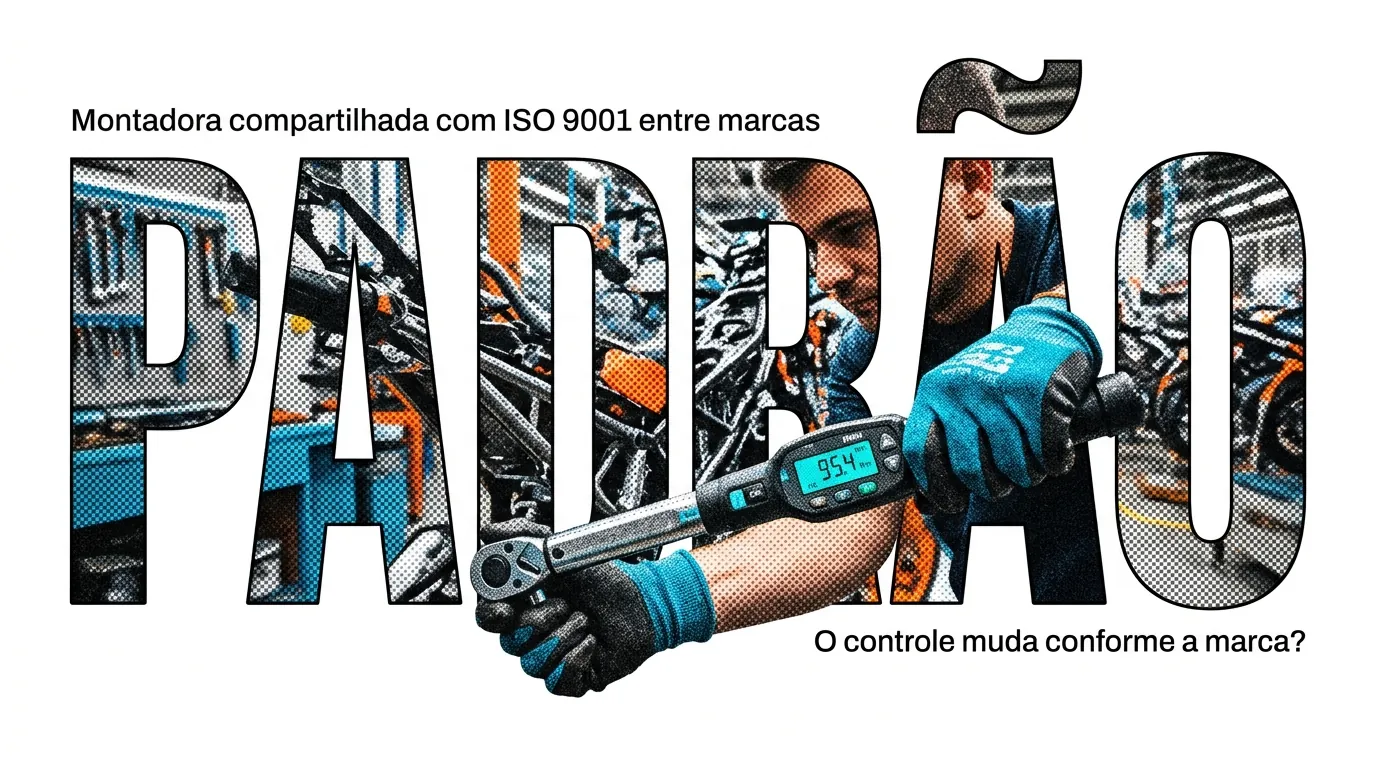
If you’re wondering what, in practice, sustains a shared plant with ISO 9001 across brands, the answer starts with torque traceability, enabled by electronic torque wrenches. This equipment automatically applies and records the torque of every tightening and fastening done during assembly, identifying which point was worked on, with what parameter, and at what moment. Without this record, there’s no way to later prove which criterion was applied to each unit assembled.
This record doesn’t depend on which brand is being assembled during that shift. It’s part of the line’s standard procedure, applied to every unit that passes through the assembly station at a shared plant with ISO 9001 across brands, which rules out the possibility of differentiated treatment between orders. The same applies to any brand operating at the same plant, regardless of volume or commercial priority.
Static and dynamic inspection works as the second layer of this control. The static inspection evaluates the product at rest, checking assembly and visual conformity; the dynamic inspection evaluates the product in operation, testing mechanical and electrical response before final release. Neither step can be skipped or simplified to speed up the release of a specific batch.
Together, torque traceability and static and dynamic inspection form the backbone of the quality system, because they’re applied by line procedure, not by a one-off decision from whoever is supervising that particular batch on a given day.
What concrete evidence shows quality control is the same for every brand?
Beyond the inspection procedures, there are dedicated equipment and physical structures that serve as concrete proof that control doesn’t vary by brand:
- Electronic torque wrenches, which apply and record the torque of each assembly step, creating an auditable history of the process.
- Dynamometer, used to test the product’s actual performance under load, simulating usage conditions before releasing the batch.
- Battery lab, dedicated to verifying the performance and safety of electrical components in electrified products.
- Inspection records tied to each batch, allowing for later audits regardless of the brand associated with the order.
- Periodic audits of the quality management system, which assess the process as a whole, not just the final product of a specific brand.
These elements make no distinction by brand because they’re part of the line’s structure, not of a specific commercial agreement. The dynamometer tests what comes off the line, and the battery lab evaluates what needs to be evaluated, regardless of who signs off on the final product.
It’s this structure, more than the certificate itself, that backs up the promise of an equivalent standard across brands producing on the same plant. The criteria applied at each of these stages are documented in DBS’s Quality Policy, available for review by any brand.
Shared plant with ISO 9001 across brands in practice: electric, combustion, and high displacement on the same plant
Imagine a line that receives, in the same week, a batch of electric motorcycles and a batch of higher-displacement combustion motorcycles. This is exactly where a shared plant with ISO 9001 across brands has to prove its control holds up across different architectures, with distinct assembly requirements. Neither batch can leave the line without going through the same control points set out in the management system.
What keeps the standard in this situation isn’t treating both batches the same way, but applying the same rigor of control to each, respecting the specific technical requirements of each technology involved. Treating both batches identically, ignoring these technical differences, would create control failures instead of preventing them.
This requires the battery lab to step in for the electric batch and the dynamometer to assess the mechanical behavior of the combustion batch, each at the appropriate control point, but both within the same management system that defines a shared plant with ISO 9001 across brands. Each stage follows the inspection script set out for that specific technology, with no shortcuts.
This is exactly the scenario a shared plant with ISO 9001 across brands has to sustain: equivalence of rigor, not identity of process, since each technology has its own critical control points.
How DBS guarantees the same quality standard for every partner brand
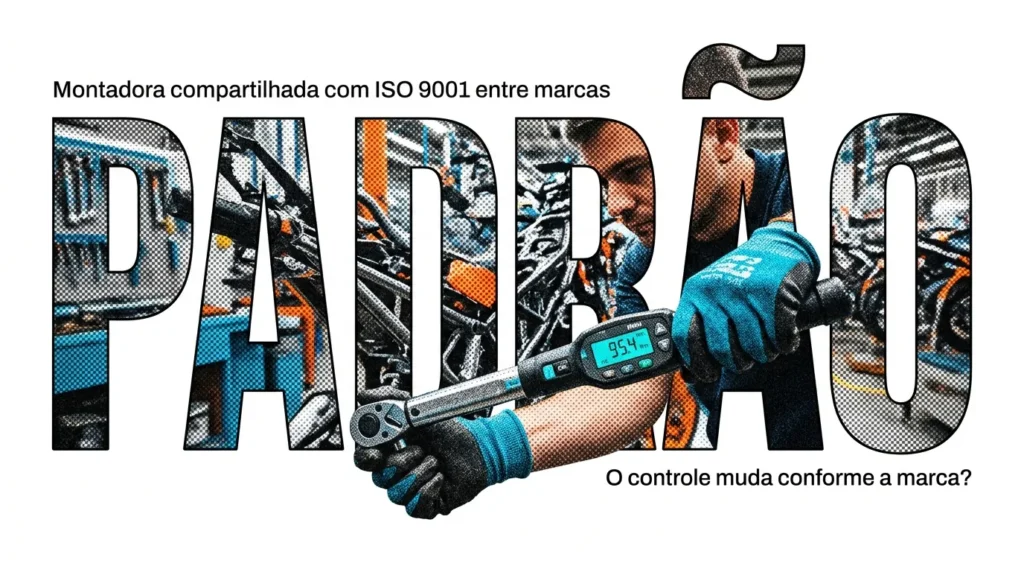
DBS runs its plant in the Manaus Free Trade Zone with ISO 9001 certification, applying torque traceability, static and dynamic inspection, a dynamometer, and a battery lab within a management system common to every batch, regardless of brand. No control stage is simplified based on order volume or length of partnership; controls and processes are adjusted to each product’s technical requirements.
More than 12 brands already produce in Brazil using DBS’s motorcycle factory, including names like Vammo, Avelloz, and Moto Morini, which requires this single quality management system, applied consistently to every order that enters the line, from receiving inputs to shipping the finished product. Each of these brands goes through the same management system, with inspection points adjusted to its product’s specific requirements.
Can your brand also operate with this standard of control, without setting up its own manufacturing structure? Talk to DBS’s team on WhatsApp and understand how the operation applies to your product. DBS integrates engineering, quality, and logistics into a single system, eliminating the need for constant physical presence to ensure compliance.